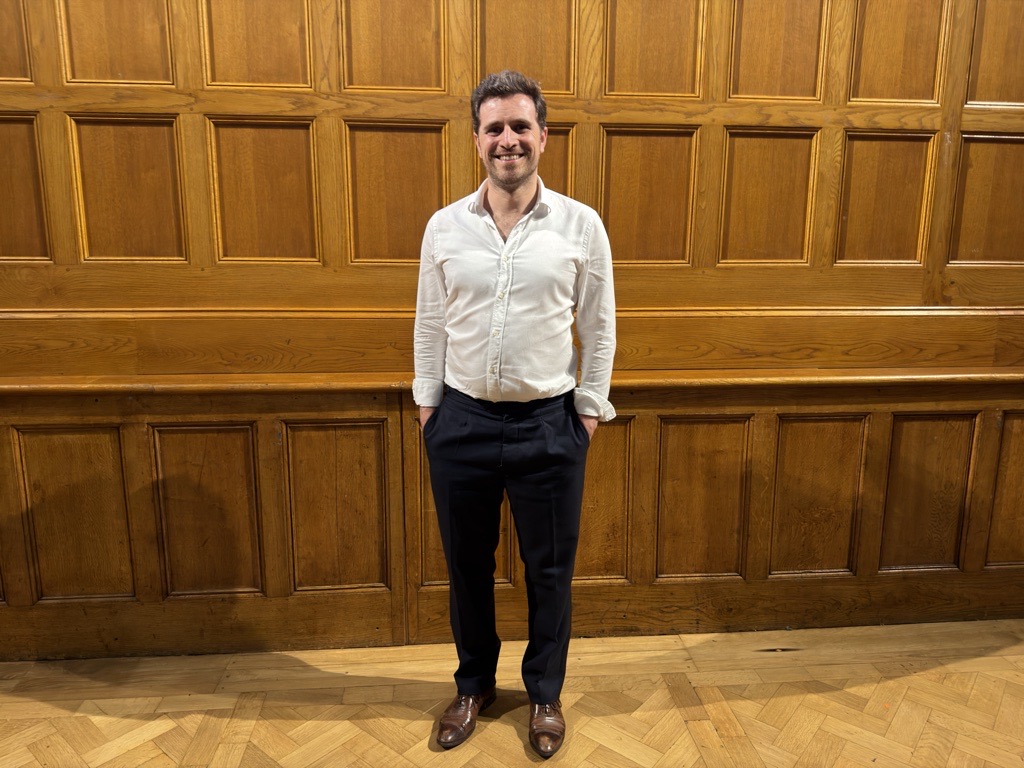
Last Friday, We were honoured to host Professor Kostya Novoselov, world‑leading physicist and Nobel Prize winner, for an afternoon of inspiration, discovery and discussion with pupils and staff.
Professor Novoselov received his Master’s degree from the Moscow Institute of Physics and Technology, before beginning his research career in Russia. He later moved to the University of Nijmegen in the Netherlands and, in 2001, to the University of Manchester. He is now the Tan Chin Tuan Centennial Professor at the National University of Singapore.
In 2004, working alongside his then‑supervisor Professor Andre Geim, Professor Novoselov succeeded in isolating graphene for the first time. This groundbreaking discovery led to the pair being jointly awarded the Nobel Prize in Physics in 2010, making Professor Novoselov one of the youngest recipients of this prestigious award.
Graphene is a material just one atom thick. Despite its extreme thinness, it is exceptionally strong, a good conductor of heat and electricity, and almost entirely transparent. These remarkable properties have transformed modern science and technology, opening up new possibilities across the materials and electronics industries.

During the evening lecture, Professor Novoselov reminded the audience that many of the greatest scientific breakthroughs come from curiosity, persistence, and a willingness to experiment… even when ideas might fail. He fascinated us with his research. For example, who’d have thought that you could levitate a frog in a magnetic field, or that self-healing materials are currently being developed!
Earlier in the day, some of Oundle’s science pupils had the rare opportunity to work directly with Professor Novoselov, manufacturing and observing graphene, and asking him questions about his research and discoveries. For many, a particular highlight was the chance to see (and even hold) his Nobel Prize medal.
We are extremely grateful to Professor Novoselov for so generously giving his time and for inspiring the next generation of scientists.