The Mediterranean Island of Sicily has long been the bridge between continents and cultures, all of which have left their mark on the island. This is the past land of the Carthaginians, Ancient Greeks, Romans and Normans and as of Autumn 2025 Oundle School also ventured to this societal crossroad to see what they could discover.
Our first site was the ancient Greek theatre and unfinished temple at Segesta, located Northwest of the Island. Here up Monte Barbaro lay a 5th century theatre which due to being located 440 metres above sea level came complete with a view over the rolling hills and distant mountains. After a short descent downwards, we encountered the unfinished temple – unfinished in the sense that the roof, inner chamber and column fluting were all absent. However, the Segestans never intended to complete the monument as its use was solely to trick the potential Athenian allies into believing that the Segestans had wealth and power. The day ended with our first taste of Italian spaghetti, a game of cards and a welcome rest.
Our second day began by visiting the capital of Sicily, Palermo. Conquered by the Normans in the late 11th Century, this city is still marked with the settlers’ influence. One of the greatest examples is the grand Monreale Cathedral, begun in 1174, whose huge exterior and intricately detailed mosaiced interior made this a trip highlight (English history also managed to make an appearance, with a depiction of the recently murdered Saint Thomas Becket!). Next on the itinerary was Selinunte, an Ancient Greek city destroyed by the Carthaginians in 409 BC; what’s left today is a 270 hectares large archaeological park, dotted with impressive temple ruins. We had a good time wandering the site, and after yet another ice cream and a game of cards we made our way to the next hotel.
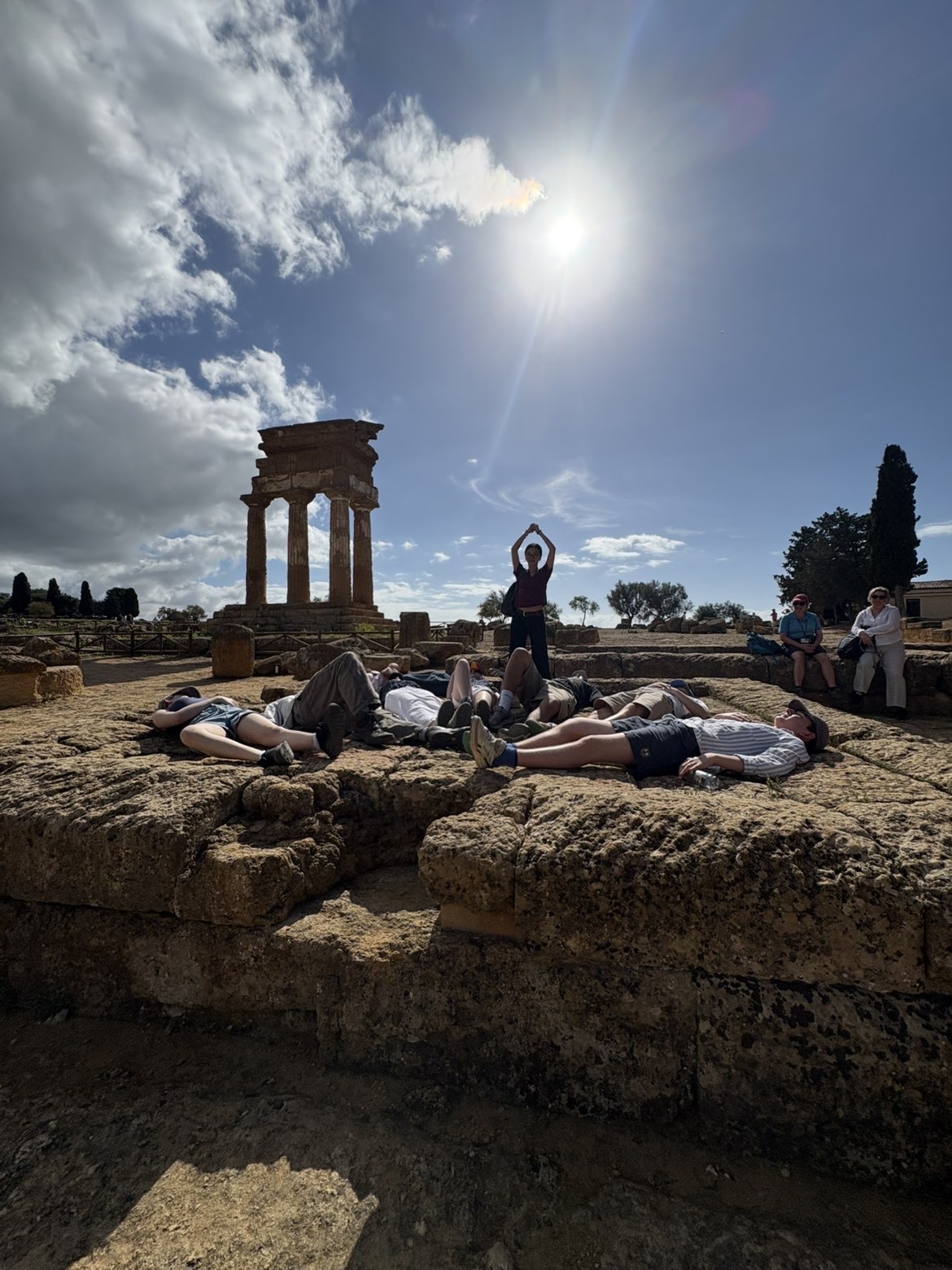
The valley of the temples is an archaeological site located outside of Agrigento, and is home to seven main temples, all built in the Doric order. Most famous is the Temple of Concordia, the best-preserved monument on the site, which showcases the elements of Ancient Greek temples we had heard so much about. Other notable remains were the temple of Zeus which lay completely in ruins, yet in its heyday this building was colossal, measuring over 32 metres tall (roughly the same height as Brazil’s Christ the Redeemer). After a quick exploration of the other five temples, we had more ice cream and made the short journey to Villa Romana del Casale. This 4th century Roman Villa contained remarkable remains of exquisite Roman mosaics, covering approximately 3,500 square metres. The pictures offer a glimpse into the life of the Romans, as laid out before us were depictions of everyday life, the transportation of exotic animals to gladiatorial games and even scenes from Homer’s Odyssey.
Day four began with an early start, preparing us for the trip across the Strait of Messina (supposedly the dreaded home of the infamous Scylla and Charybdis), to see the Raice Warriors on mainland Italy. Renowned for their historical and artistic significance surrounding the Romans use of contrapposto (made clear by Mrs James’s demonstration prior) the two bronze figures didn’t disappoint. Following this, we returned to the island, visiting the city of Taormina. The place was beautiful and after a swift meal the group reconvened at Taormina’s Ancient Roman Theatre, a monumental building (potentially seating over 10,000 people) overlooking Mount Etna. To our surprise, our trip aligned with a grand wedding taking place at the same venue, complete with the groom’s descent down the aisle suspended by huge helium balloons.
The morning of our last day in Sicily was spent touring around Syracuse’s ancient quarry which became a prison camp for the captured Athenian prisoners of war, after Sicily’s defeat of the Athenian Expedition 413BC, a significant event in the Peloponnesian War. Also at this site was another theatre, which was likely built in the late 1st Century BC, which overlooked the quarry. The remainder of the day was spent on Ortygia, a small island renowned for its cultural past, where another trip highlight was the extremely enjoyable boat trip around the island, which I hear is a Sicily trip tradition.
We spent our last evening chatting and reminiscing about how great the week had been, the photography competition’s winner was announced, and the last ice cream was eaten. The trip had been unforgettable, and a standout of my time at Oundle.