Every school develops its own vernacular over the years to form a shared set of informal phrases and words shaped by pupils’ daily experiences and routines with common understanding. From firmly embedded terminology to nicknames and shorthand for familiar moments in the school day, here are a few that feature in the ‘Oundle Dictionary’:
Simply another name for lined paper, block is one of the most common slang terms in Oundle: every pupil is aware and uses it on a daily basis.
Given that most lessons are conducted using a projector and OneNote pages, teachers can give specific requests for essays, maths questions, or work of any other form to be done on block. This is particularly useful when trying to guard pupils against the lure of technological distractions.
Often described as the best part of the day, break is, as with any other school, our morning rest period between lessons.
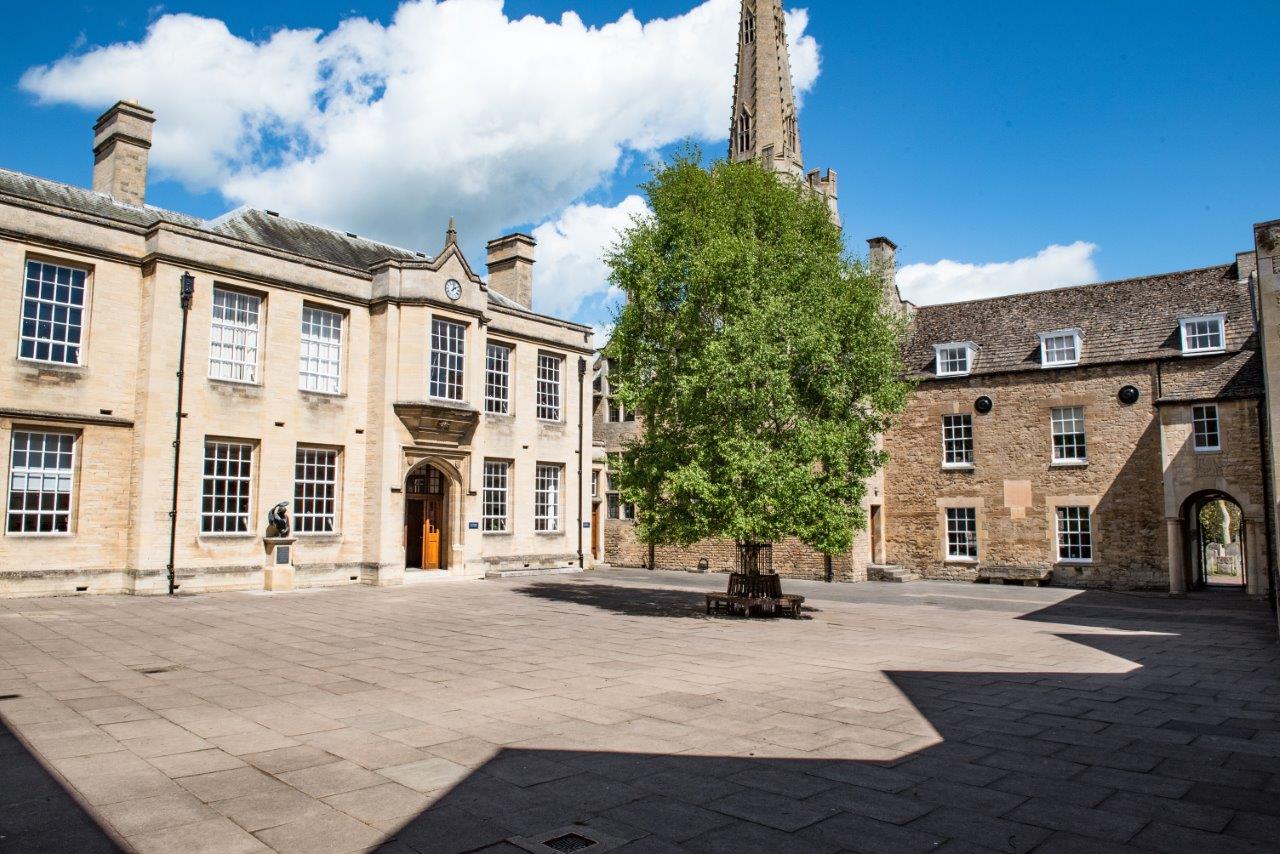
Oundle however takes break to a new level. Starting at 10.40, with stomachs growling, all pupils head towards Cloisters to meet their friends. Some take the more relaxed approach, rocking up at Cloisters ready to find someone on the spot, while others are more organised, booking in their break ‘date’ the evening before (or sometimes many evenings). Either way, after finding your break buddy, everyone heads to town, along the well-trodden path to Co-op, Tesco’s, Cookies, the newsagents – the list goes on.
Co-op however, is the most popular choice for most; pupils line up outside while a prefect controls the queue into the shop. Once inside the carefully monitored mayhem, the next thing is to decide what you are going to buy for break. While this may seem an easy task, it certainly is not and often requires pre-thought and discussion in period 2. Common choices for break snacks include freshly baked cookies (the squishy ones), bread and hummus, crisps, grapes and drinks.
Thursday offers something different to the break agenda. Every week Oundle holds a market in the town square, where pupils go to buy fresh fruit, and baked goods such as cookie pies. People tend to take most heed of the burger stall, and most recently, the Mexican quesadilla van.
Break can also be seasonal. In summer, pupils tend to opt for an ice lolly, or summer fruits, while they bask in the heat trap of Cloisters for half an hour. The winter however encompasses something more warming, like a chai latte and a warm cookie. Come rain, some head towards the Lemon Tree, or Beans if the soggy paving stones of Cloisters seems unenticing.
This abbreviation is used exclusively by Sixth Form pupils, and it is an Oundle term short for ‘Private Reading’. Other schools may refer to these periods of self-studying as free periods, or more simply, frees; however, we are encouraged to see these as periods in which to read around our A level subjects, completing prep in our allotted evening prep time- though in reality most of this time is used to tackle the workload.
A popular place to spend this time is the Cripps Library, where a quiet and inviting atmosphere allows for clear thought processes and effective work. Some pupils prefer to work in-House, with a closer proximity to their own notes and personal working space.
At the beginning of Lower Sixth, PRs are a novelty and they begin in low supply. As most Lower Sixth pupils begin with four A levels before the opportunity to drop a subject, this results in four PRs per week: one for each subject. Opting to participate in private music lessons and MFL (Modern Foreign Language) A levels, usually results in PRs being taken up. This is either to be dedicated to your weekly music lesson, or a one-on-one speaking lesson with Language Assistants to prepare for Language speaking exams – which is a unique initiative and opportunity for Oundelians to practice their subject with advanced speakers present for guidance.
Later, most pupils opt to drop a subject, which results in approximately ten PRs per week. This seems like a lot of time available to waste, but given we work on a 6-day timetable and must balance prep with ongoing revision and extra-curriculars, it is incredibly easy for Oundelians to fill this time with productive tasks. This is especially useful around September-November of Upper Sixth, which is the time during which most UCAS applications and Personal Statements must be completed.
Similarly to many other schools, Oundle offers Lower Sixth pupils the opportunity to write an EPQ (Extended Project Qualification) on their topic of choice. What makes Oundle stand out, however, are the alternative options to EPQ: namely, Quadrivium and ab-initio language qualifications. Quadrivium involves a small group of pupils participating in subject-specific ‘lecture-like’ sessions with a teacher who is qualified in the subject. There are usually 10-12 course options available, with lab-work often being included in the science groups. This is ideal for a display of independent yet observed work, mimicking university cohorts and more student-led approaches to learning. It also helps pupils to discover a niche area of interest within their subject, which is essential for the compilation of Personal Statements.
This is a term describing Sixth Form pupils who journey exclusively to SciTec, on a daily basis, for all their lessons. Common subject combinations include Biology, Chemistry and Maths, specifically for those intending to study Medicine or BioMed at university.
Taking lessons in the same building, multiple times a day, six times a week, may seem daunting to most, however the modern look and upbeat feel of SciTec make it an enjoyable place to be. The glass features and skylights make the space feel even bigger than it is, and familiar faces surround each SciTec Warrior in each department.
Some SciTec Warriors go as far as spending every break-time in the building too, lounging and chatting away on the sofas outside classrooms. These sofas are also available during lesson time for Sixth form pupils in their PRs (referenced in separate paragraph), and they provide a comfortable space for productive work to occur.
An enemy to some, the Gale Mile is only a yearly occurrence and brings to the surface Oundle’s competitive house spirit. As hinted by in the name, the Gale Mile is a mile-long relay race around the rugby pitches. Starting with a gentle downhill, runners eventually face the long and brutalising uphill stretch, before a sprint finish to the end, where they are greeted by the whole school lined up along the sides.
The race has been run by Oundelians since 1863, but the Gale Mile Cup was first awarded in 1930, in memory of Robert Gale (Berrystead and School House) who was killed in a motor accident three years after leaving the School.
Similar to the Gale Mile, Oundle must have its own name for our Inter-house Swimming Competition. The Lomax Cup is usually held in October for the boys’ and November for girls’ Houses. While swimming may not be everyone’s strong suit and for some, their worst nightmare, the Lomax differs from House Cross Country as only those who volunteer will participate in this competition. However, a great number of non-swimmers regularly take part in events while their peers cheer from the sidelines.
The name comes from an other Old Oundelian: Peter Lomax, a talented swimmer and diver, entered Dryden House in 1934 and left to join the RAF in 1937. He was killed on active service during World War II.
Vols are subject-specific support sessions available to join each Tuesday and Thursday afternoon. This is an Oundle-unique opportunity for pupils to clarify any syllabus points they may not be clear on, with a teacher from each department present every session. Instead of having to book extra lessons, going to Vols gives pupils the opportunity for one-on-one consolidation of new information. When struggling in a particular area of a subject or following a disappointing test result, Vols are the best place to be. Having other pupils present and asking for help may also open your eyes to something you didn’t think needed further explanation, proving to be a very useful way to spend the afternoon.