Peru in a single word: vibrant. Vibrancy in the chains of multi-coloured pom poms floating in doorways, vibrancy in the liveliness of the different languages we encountered and in the smiles of friendly faces with stories to tell, vibrancy in the colours we saw in the countless landscapes and the passionate preservation of the Incan culture.
The trip, was for Spanish and Geography pupils, though not exclusively so, and was led by Richard Charters, Head of Spanish, who despite encountering obstacles kept his composure magnificently. He was assisted by Mrs Yarker and Mr Macdougall who always volunteered a smile and a nugget of knowledge to bring our surroundings to life, and also by our wonderful nurse, Lucy Booth, who was essential to the wellbeing of every pupil.
The first hurdle was when our flight to Bogota, Colombia, was delayed by a day, and the next connecting flight to Cusco was in three further days time. Instead of moping around our temporary Heathrow hotel, Mr Charters created an entirely new itinerary on the spot for a fascinating two day introduction to Bogota, including visiting the Museo Del Oro (museum of gold) to get a taste of the immaculately preserved and deeply spiritual roots of Colombian and Peruvian history; the Incan empire became such by means of their study of metallurgy. In our exploration of the bustling, graffiti-covered city, we also tried our hand at bargaining at the Usaquen flea market and explored the vast cavernous salt cathedral in the nearby city of Zipaquira, enjoying traditional cuisine and music at lunch.
Once we arrived in Cusco, Peru, at a height of 3,400m above sea level, our bodies gradually acclimatised to the altitude. We met our cheerfully cheeky guide Miguel, who had lived around Cusco throughout his life and who enriched our time with all sorts of facts and jokes, such as at our first lunch in the city when he managed to convince the group that we had eaten guinea pig cheese!
We cycled near the Sacred valley, through quaint villages with vistas of magnificent mountains, and white water rafted in the Urubamba River. We navigated the foaming waters and steep drops together, each more thrilling than the last, surrounded by the beautiful canyon and towering peaks. The sauna afterwards was a very welcome treat for all our shivering bodies.
We relaxed and indulged in warm beds at our wonderful Cusco hotel, which many described as a home away from home by the end of the trip, while thoughts of the looming Salkantay Trail and camping were looming at the forefronts of our minds. The next day, with early mornings by then having become the norm, we drank coca tea in an effort to wake us up and energise ourselves for the challenging day ahead.
The Trail was the most rewarding hike I have ever accomplished. Our first, and most rural campsite was at an altitude of 3,800m. We had hiked to the sapphire blue waters of Humantay lake earlier that day, and were ready for a rest, so curled up for warmth in our cosy two-man tents.
Day two of trekking began in the magical half light before dawn. We set out for Salkantay Pass at 05:30, before the sunrise, which allowed us to get halfway up the mountain before the warm, radiant fingers sunlight which extended over the snow-capped peaks. Our walking guide, Louis, raised his hands to the sun and thanked Pachamama, an earthly god of the Incan religion as he felt the beams touch his face.
Supported by the mules, which carried our tents, we scrambled and climbed up to the top of the pass, at a height of 4,600m and celebrated by admiring the panoramic views of the second highest point of the Cusco region. On our descent from this mountain we were blessed by catching sight of two elusive condors, a bird which represents the portal between the earthly world and world above in Incan religion. They are the largest living flying birds, with a wingspan of ten feet on average. As our knowledgeable guide explained, when the Spanish conquistadors took control of Peru in the late 1400s, they forced the native peoples to kill the birds, which were sacred to them, resulting in their now only being six-hundred across the entire Andes range. We were truly lucky to have seen not one, but two scaling the summits.
Every day on the trek our surroundings changed, from dry scrub to snowy peaks to tropical rainforest, and we were lucky enough to arrive at our campsites where our tents were set up and dinner would be waiting, cooked by our fantastic chef, Gregorio. It was during this stage of the trip in which the group bonded and learned how to help one another, as we realised people required support in different ways with both physical and mental wellbeing.
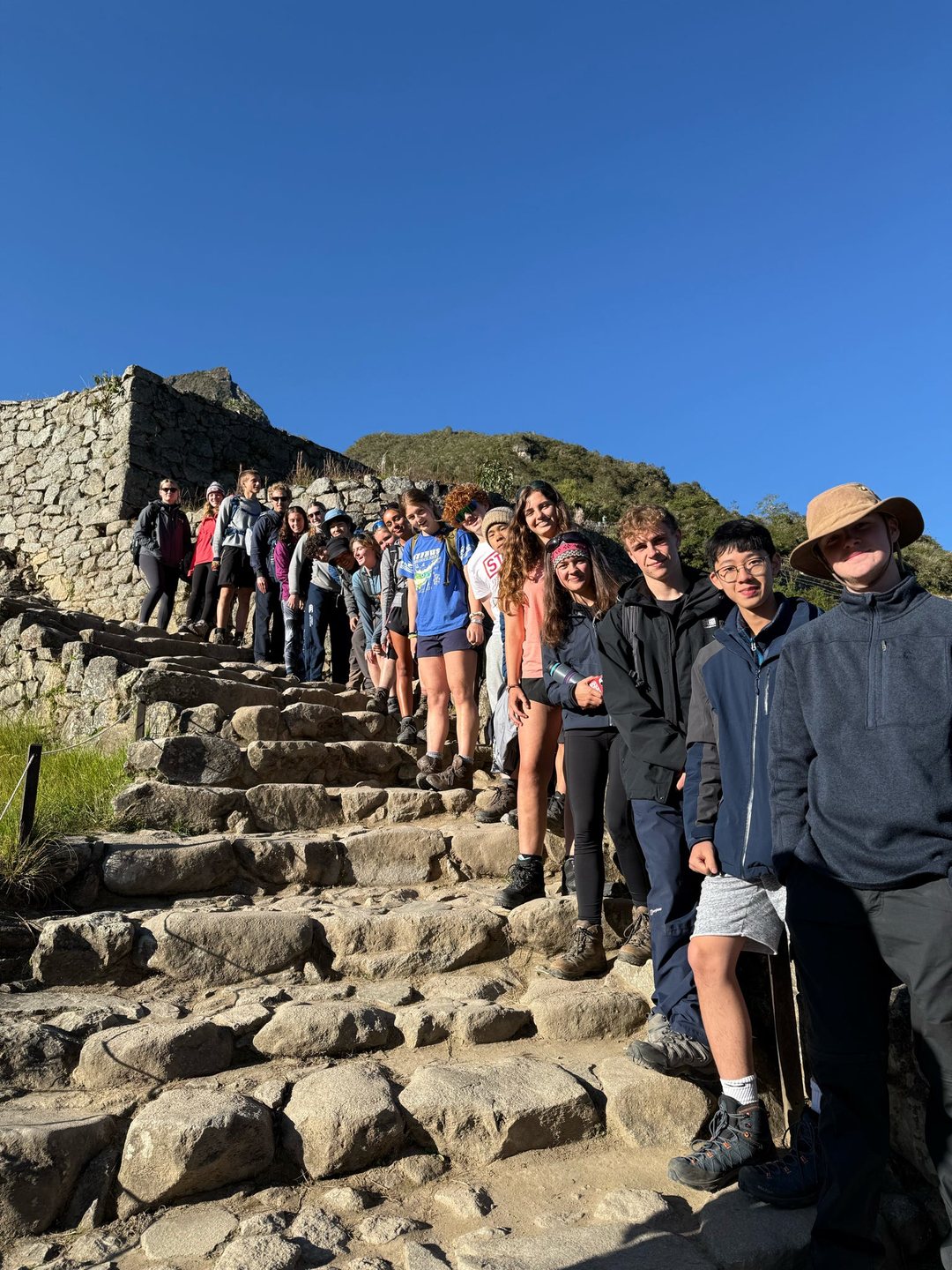
The incredible hike ended at the town of Aguas Calientes, from which we ascended via bus to visit Machu Picchu the next morning. We were in a state of collective awe of the sun as it passed over the sun gate (between the top of two peaks) and shed light on the beautiful and sacred ruins and surrounding mountains.
Our next stage of the trip took us to our highest location yet: Mount Vinicunca, the Rainbow Mountain, at a literally breathtaking height of 5,100m. The vibrant colours spread out across the landscape like a woven blanket in bands, adorning multiple peaks. From here, we travelled onwards to Lake Titicaca where we met the native Uros people who inhabit the floating totora reed islands and we also relaxed at a homestay at the charming village Luquina. The landscape had changed yet again, resembling a form of Greek coastline, where we witnessed a spectacular sunset over the calm blue waters as we took the rare chance of a rest.
The final stage of our trip was taking part in a community project in the home village of our main guide, Miguel, and enjoying their culture and traditions. From the first moment we arrived, we were embraced as family and even dressed in their traditional, vibrant clothing, before we danced and took part in spiritual ceremonies of the village.
Our final night in Peru was spent at a salsa club, where we attempted to learn the basic dance moves in a night filled with laughter and music. I now get to take home a little piece of vibrancy which I had never before experienced in the form of my own souvenirs, and the vividness of my memory. The dance was the most happy and humorous way to end such an incredible, life-altering trip, which many of us will hold dear for the rest of our lives.