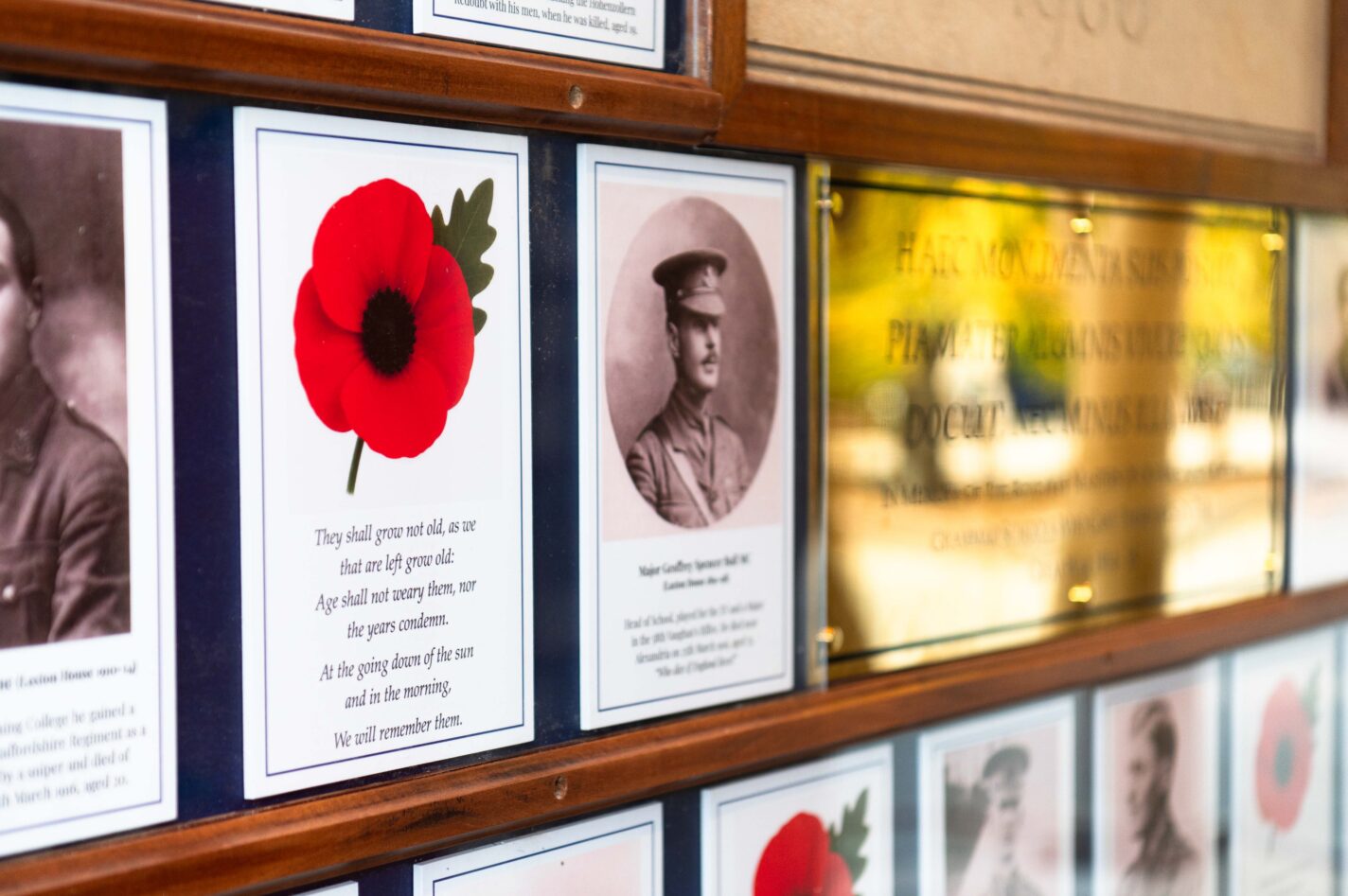
As Remembrance approaches, pupils have been encouraged to reflect on the lives and sacrifices of former Oundelians who served during the First World War, following the restoration of the School’s memorial walls in Cloisters.
The memorial commemorates the 266 Old Oundelians who lost their lives during the war. Over half-term, the walls were repainted and the individual photographs carefully reprinted, reframed and remounted, ensuring that the stories of those remembered remain visible to future generations.
The original photographs were installed between September 2014 and November 2018, as part of a four-year programme of remembrance marking the centenary of each Oundelian’s death. Houses gathered in Cloisters for individual services, remembering each former pupil exactly 100 years after they had fallen. Starting in the south-east corner of Cloisters, nearest the Library, the photographs are arranged chronologically and then alphabetically by date of death, concluding in the north-east corner nearest St Peter’s Church.

In Remembrance addresses delivered by Mr Mansergh, pupils were invited to consider the young men behind those photographs, many of whom had walked the same streets, lived in the same Houses and shared much of the same daily experience as Oundelians today.
Among them are Samuel Edwards, the first Old Oundelian to lose his life, killed in East Africa, and Herbert Markham, the last, who died as a prisoner of war in a German hospital. The memorial also remembers Charles Andrews, the oldest at 45, and John Savage, the youngest, a pilot of just 17 whose aircraft was shot down.
Of the approximately 1,200 Old Oundelians who served during the First World War, 266 lost their lives. Thirty-two died during the Battle of the Somme in 1916, while 14 were killed during the Gallipoli Campaign. Almost all had been pupils during the headmastership of F. W. Sanderson.
Drawing on Philip Larkin’s poem MCMXIV, with its closing words, “Never such innocence again“, the addresses reflected on the profound impact of the First World War, both on the wider world and on the community of a single school in a small Northamptonshire town.

Yet the central message was one of gratitude. Pupils were reminded that those commemorated were not simply names from history, but young people with friendships, ambitions and futures ahead of them.
The addresses closed with a reflection from Dietrich Bonhoeffer, who wrote while imprisoned for his opposition to the Nazi regime: “In ordinary life we hardly realise that we receive a great deal more than we give, and that it is only with gratitude that life becomes rich.”
As the School marks Remembrance, the restored memorial offers a lasting opportunity to pause, reflect and remember the generations of Oundelians who went before us, and the sacrifices they made.