Following an entry to Articulate, a competitive contest requiring the presentation of an artwork of interest, I have transformed my presentation on Le Petite Danseuse de Quatorze Ans into a critical appreciation of the sculpture that considers Degas’ position in Parisian society at the time.
Edgar Degas’ Le Petite Danseuse de Quatorze Ans, has long occupied a paradoxical position within the history of art. First presented by Degas at the sixth Impressionist exhibition in the spring of 1881, it has been celebrated as a masterpiece of modern sculpture ever since. Though praised for its startling realism and innovative materials, it is simultaneously one of the artist’s most controversial works. While some have interpreted the sculpture as a sympathetic portrayal of a working-class ballet student, such understanding risks overlooking the profound power imbalance embedded within both the work and its creation. Through his privileged position within the Paris Opera, his construction and display of Marie Van Goethem’s image, and his lasting control over her historical legacy, Degas emerges as a puppeteer whose influence extended over the lives and representations of vulnerable girls.

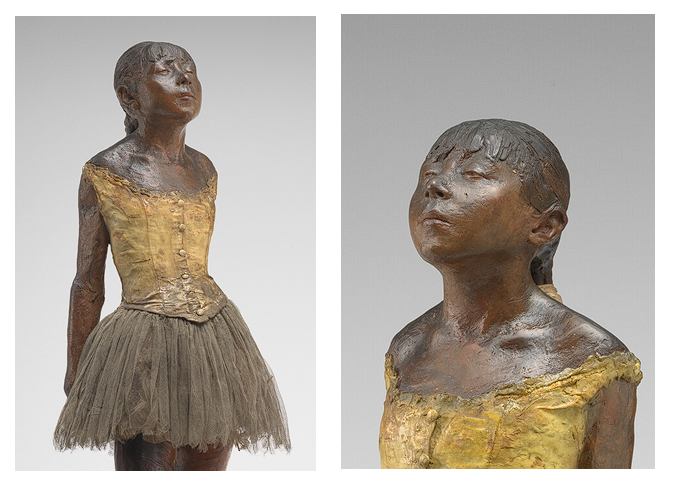
The metaphor of the puppeteer is particularly compelling because Degas quite literally constructed Marie’s body according to his own design. Petite Danseuse de Quatorze Ans was built around a framework of hollow lead pipes, wooden supports, rope and paintbrushes that function as an internal skeleton. Upon this armature, Degas layered clay and molten beeswax before meticulously modelling every aspect of the figure’s appearance, from the contours of the face to the fingernails of the hands. He then dressed the sculpture in a real bodice, real ballet slippers and a wig of human hair. The resulting figure blurs the boundary between person and object. Marie’s body is not simply represented; it is reconstructed, assembled piece by piece according to Degas’ wishes. In this sense, the sculpture becomes an act of possession. The artist determines not only how Marie appears, but how she is understood.

The materials used to create this sculpture reinforce this dynamic. Today, audiences are most familiar with the twenty-eight bronze casts produced after Degas’ death, yet the original sculpture was made primarily of wax. This distinction is significant. Bronze traditionally conveys permanence and authority, transforming its subjects into enduring monuments. Whilst wax, by contrast, is fragile and vulnerable to decay. Therefore, Degas’ choice of material mirrors the precarious existence of the young dancer herself. Marie Van Goethem occupied an uncertain social position, balanced between the possibility of success and the threat of poverty. The ephemeral nature of the wax reflects this instability. Ironically, the later bronze casts obscure this reality, converting a sculpture originally characterised by vulnerability into a permanent icon. Just as Marie’s own identity became subsumed beneath Degas’ artistic construction, the material truth of the original sculpture has been eclipsed by the bronze sculptures that dominate museums today.
The social context surrounding the work further complicates any attempt to view Degas as a detached observer. Marie Van Goethem was the daughter of a Belgian tailor and a laundress, a background typical of the girls known as petits rats within the Paris Opera. These young ballerinas, from impoverished families who viewed ballet as a potential route out of hardship, were often offered a route into ballet society by the opera’s administrator Louis Veron. Yet such aspirations rarely materialised. Following the decline of the Romantic era and the financial difficulties experienced by the Paris Opera in the late nineteenth century, many dancers found themselves competing for increasingly limited opportunities. Those who failed to achieve the status of prima ballerina often faced an uncertain future.
Within this environment operated les abonnes, the wealthy male patrons who funded the Paris Opera and enjoyed privileged access to its performers. Degas belonged to this exclusive circle, set up by Veron, called Le foyer de la danse. As one of the institution’s “backstage gentlemen”, he occupied a position of considerable social power. The structure of the Opera itself placed vulnerable working-class girls in direct contact with affluent men capable of influencing their careers and livelihoods. Although there is no evidence that Degas maintained a sexual relationship with Marie Van Goethem, his participation in this system remains significant. He was not simply documenting inequality from the outside; he benefited from the very structures he depicted. The puppeteer, after all, does not need to invent the strings in order to pull them.
Le Petite Danseuse de Quatorze Ans remains a remarkable artistic achievement. Its innovative materials and challenge to sculptural convention justify its place within the canon of modern art. Yet admiration for the work should not prevent critical examination of the power structures embedded within it. The sculpture stands at the intersection of realism and exploitation, sympathy and control, exposure and objectification. Degas may have sought to reveal the realities of working-class life within the Paris opera, but he did so through a process that transformed a vulnerable fourteen-year-old girl into an object of observation. The enduring irony of the sculpture is that while Marie Van Goethem disappeared almost entirely from history, the version of her created by Degas survives.
The puppet remains; the person has vanished.