Starting out as a new pupil at this school, I signed up for the Duke of Edinburgh’s Gold Award, mentally bracing myself for the hours of menial updating of log cards and the 4-day expedition I’d have to do at some point. The reason I wanted to sign up for DofE was because I felt that it would not only help me to break the ice between myself and other pupils and to find people with similar interests to me, but also in order to feel that I wouldn’t be leaving school without having accomplished much that I could look back on proudly.
In one of the first meetings, we were shown our expedition choices which were either to do a walking expedition, the default choice for most people, or canoe, sail, or cycle. I chose to walk as I thought it would be familiar, having hiked during my Bronze and Silver expeditions. The only problem I had was that because I was new to the school, I didn’t have a group. Luckily, I was placed with a welcoming and very organised bunch of people.
For the first few months of the Award, I periodically made sure my log card was up to date with my recent activities, met up with my supervisor and caught up with my group. In terms of my physical, volunteering and skills sections, my activities were, rugby followed by hockey and now cycling as my physical activity, helping out at a food bank where I live over the holidays and for my skills section, contributing to the Oundelian blog page with new articles. If I had any advice for pupils picking their activities, I’d suggest that you pick something that you can easily get started on and won’t struggle a lot to travel to or do. This is especially important as the number of hours you’ll be doing increases with each level of the Award.
Soon after Christmas, we began preparing for our practice expedition, collecting our gear, food, maps, and making sure we had all the required knowledge and equipment for the hike.
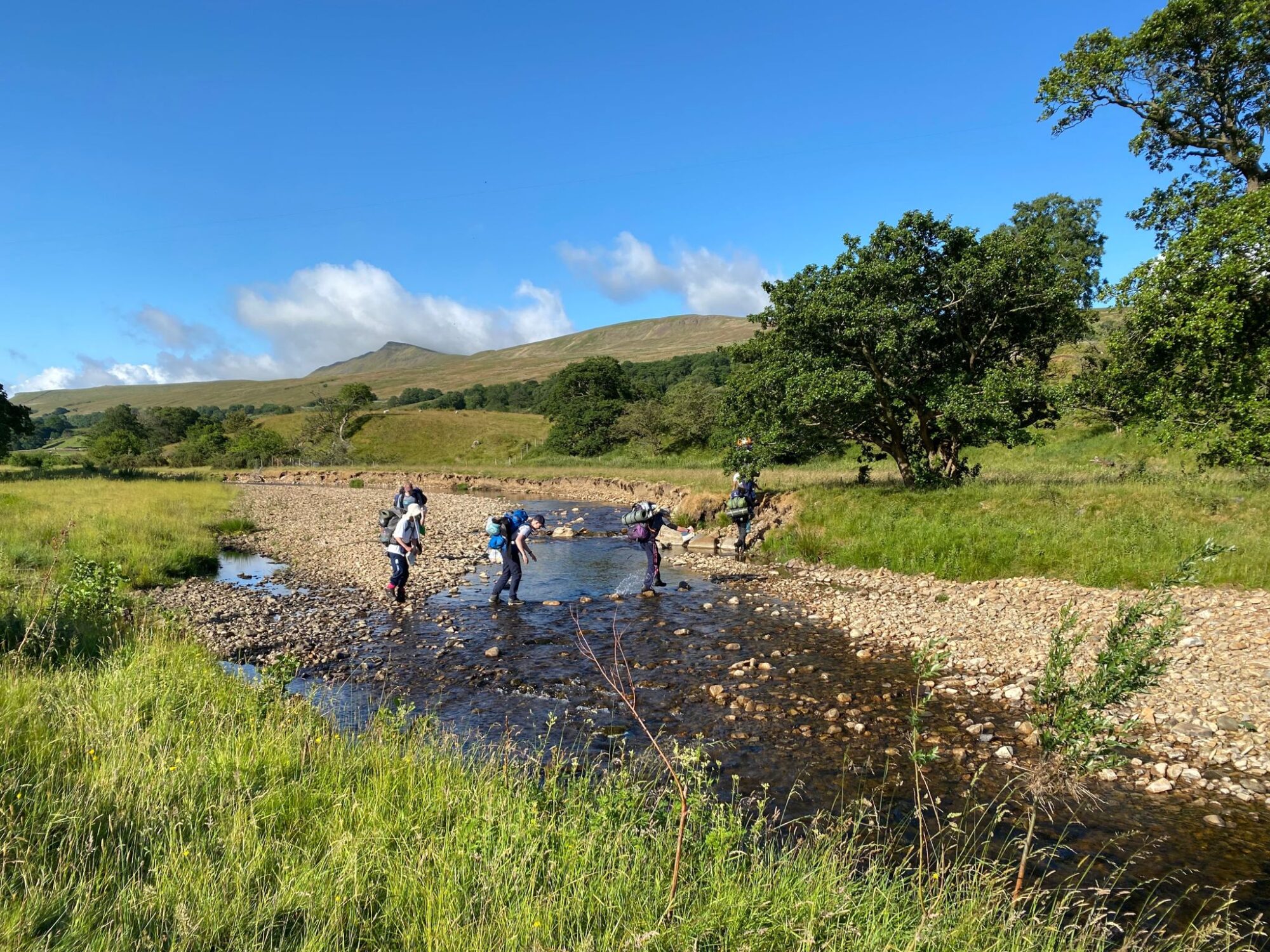
Come the Easter holidays, a few days before school started again, I was on a bus going from Oundle to Hathersage in the Peak District. After being dropped off at the train station, we opened up the maps to double check the route and wrote down any extra information like emergency phone numbers. On the first day, we set off, following our route for roughly 10km through the hills surrounding Hathersage, walking along a river for a while before climbing up the hills. The height we climbed wasn’t too exhausting but with our bags still full of food, they were quite heavy.
On the second day of the expedition, one member from each group went to a specific teacher to familiarise themselves with a certain skill, for example, navigation, first aid, etc. I was put with the group doing navigation, where we learnt about how to find our bearings and locate ourselves using a prominent landmark on the map; furthermore, we were also reminded of the concept of counting our steps in order to measure distances, which is quite useful when you’re walking through flat fields with no contours or landmarks. The day proved to be quite interesting and informative. When we got back to camp for our second night, I began to make dinner: couscous with tuna and peas, quite filling but not very flavourful. In contrast, some of my more well-prepared teammates had brought Wayfarer meals where you only have to add hot water, something I might do on my real expedition.
The third day of the expedition was objectively the longest and hardest, having planned to walk a 28km route with at least a kilometre of elevation, but unfortunately, we ended up doing more like 34km, the result of an unlucky wrong turn due to a mistake in reading the map. On that day, we were up in the moorland, with wind and rain, and occasional hail. Although we were under bad circumstances, we managed to power through and reach our camp for the night.
The last day was mercifully uneventful, a short 3km walk back to the train station, having completed our loop around Hathersage and returning to where we began.
The constant updating of log cards, synonymous with the Duke of Edinburgh’s Award, is, I believe, a great way of teaching pupils such as myself the importance of consistency and patience. This mindset can be carried over to your studies, for example, not falling behind on prep is paramount to not being overwhelmed by work. After completing my Bronze and Silver, my understanding of how to be consistent with a task has improved drastically; although it still isn’t flawless and I struggle with it from time to time, it has got better.
The importance of the DofE expedition cannot be understated, it isn’t exactly a test of your physical fitness, but more of a test of your competency in terms of organisation and planning and being able to navigate so as not to get lost. Another important aspect of the expedition is the shared experience you receive, hiking in a group with your friends, sharing stories in your tents at night, and eating meals together. I would recommend the DofE’s Award to any pupil who is struggling to find a productive way to spend their free time as well as anyone looking to make new friends and experience new things. In the final expedition, I am looking forward to not only the satisfaction of having completed such a long hike once we’re finished, but also the scenery and challenge of the expedition.
Overall, the DofE Award as an experience is an invaluable lesson in organisation, consistency and planning, with the added benefit of possibly making good friends along the way.