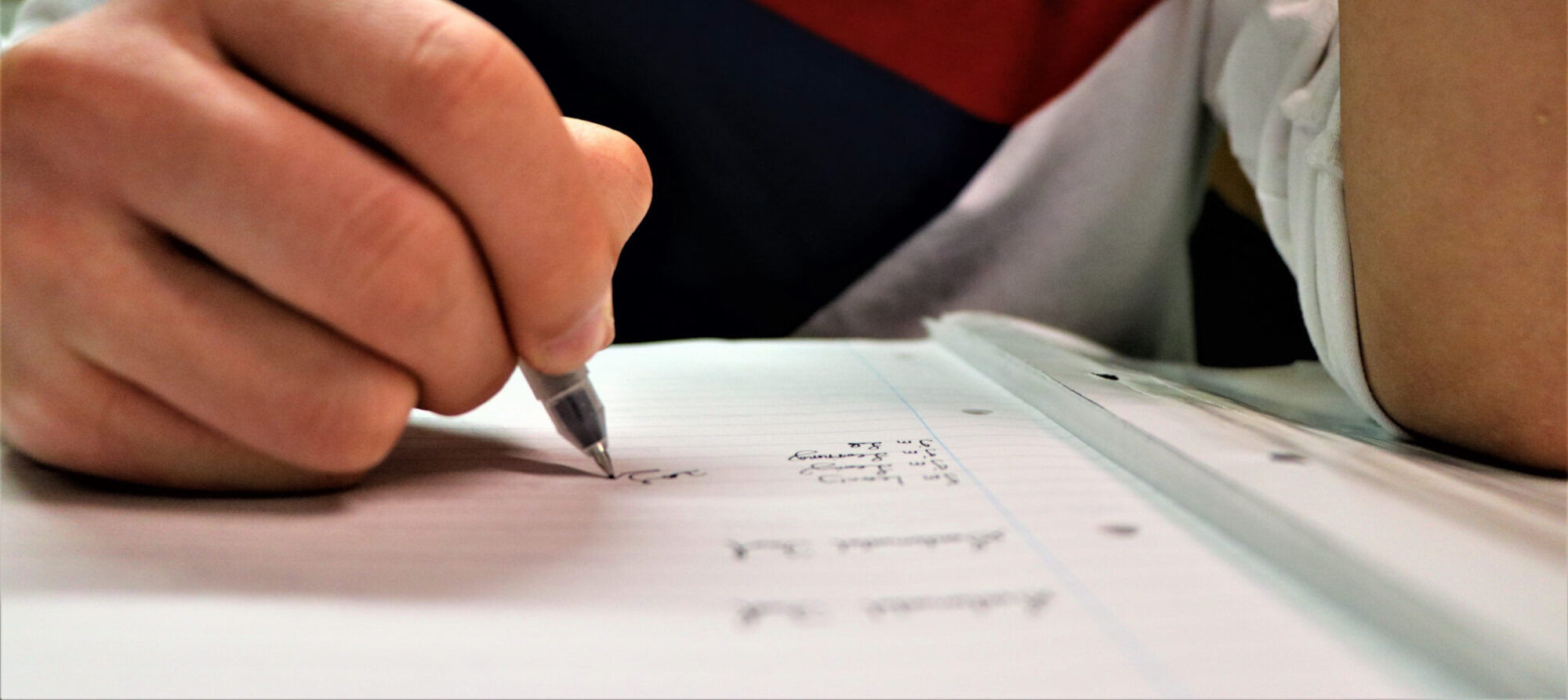
Schools now suggest that revision notes are insufficient for learning, suggesting instead that spaced repetition and interleaving are the way forward. However, I would propose that with a modern twist your notes could function as an active recall exercise at the cutting edge of educational innovation. State-of-the-art developments in illegible handwriting offer the solution. The old-fashioned note re-reader can engage with their material fully, testing their knowledge by filling in the unintelligible gaps: the ultimate cloze exercise.
Despite the absurd premise, this is genuinely an observation I have used to justify my appalling handwriting – it is absolutely not the case that you can always read your own work. This was not always the case for me though. Going to primary school between 2013 and 2019 meant that cursive handwriting lessons were an important element of the syllabus. However after this, my peers and I were let loose on secondary school with our carefully “joined-up” writing that, for the less aesthetically conscious, would soon be bulldozed. My generation have gone through school with handwriting measures in the primary but not secondary curriculums. Along with the widespread integration of computers post-COVID, my age group exhibits a worryingly wide range of penmanship skills.
For me, the demands of secondary school and less vigilance on handwriting meant that speed was far more important to me than perfect joins between each letter. The realisation that I could write incredibly quickly, sacrificing neatness, was the beginning of a fast decline in my handwriting. Then came lockdown which meant that typing became a far more prevalent practice that has not seemed to have left since. I rapidly reached the point of teachers asking me to decrypt my writing, red notes on my work and threats of zero marks. This was easy to ignore and supplement with typed submissions until the prosect of public exams loomed.
The issue of examiners simply not understanding my work became a very real worry that demanded dedicated practice much resembling the key stage 2 lessons I had readily undone. With significant work I could just about get back to the point of legibility but pupils who have never worked on handwriting may be less lucky. Generation Alpha, who are currently in primary school, are introduced to computational work much earlier and less mind is given to handwriting, writing it off as an antiquated part of education.
The issue with this though, is that handwriting is simply more “educational”. By this point in the computer age, it is well known that the more active process of writing by hand aids memory much more effectively than typing but research shows this effect dominates multiple metrics. These include: accuracy of recall, depth of conceptual understanding and even brain activation (Keita et al., 2021). Here at Oundle, these principals are reflected in the School’s Handwriting Policy, an important part of academic approach, particularly considering that public exams remain handwritten. There is a responsibility taken on as a school to maintain the practice as opportunities elsewhere dwindle.
However, this trajectory of digitalisation will undoubtedly engulf public exams eventually as it already has in many institutions and countries. In the UK, GCSEs and A-levels moving online would almost certainly bring about the “death” of handwriting. There is something sentimental about this looming loss of a human practice but there will also be an irrefutable impact on the learning process. We appear to be falling victim to, what educationalist, Neil Postman, describes as the “delusion to believe that the technological changes of our era have rendered irrelevant the wisdom of the ages”.
This is not to say I lament the loss of the level of calligraphy taught and expected of students a number of generations ago. In my education, the only point in 5 years of secondary school that demanded me to care about my handwriting was my GCSEs. Maybe working on a skill for only this purpose is unnecessary when more and more aspects of life become digital. However, what this certainty provides is a study into how attention must to be paid to the consequences of modernisation; maybe scrawly handwriting is the new avant-garde.