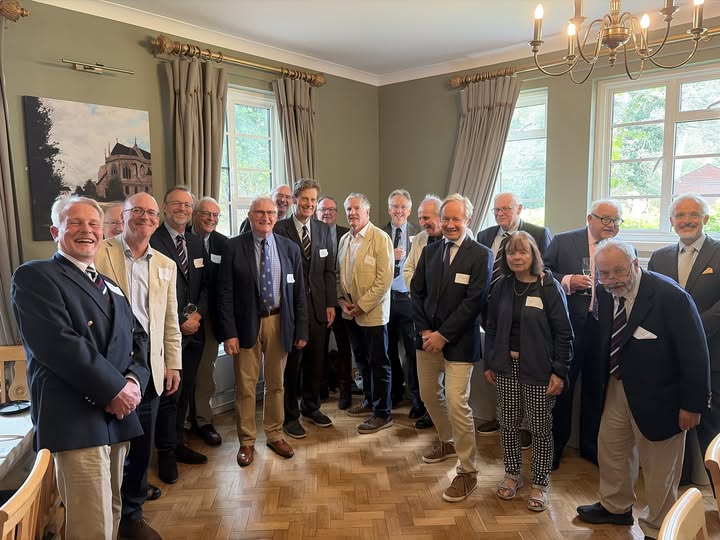
On Saturday 19 September, Old Oundelians returned to Oundle for a special lunch celebrating the Headmastership of Dr Barry M. W. Trapnell CBE, who led the School from 1968 to 1984.
The occasion brought together those whose time at Oundle coincided with the Trapnell years, offering an opportunity to renew old friendships, share memories and celebrate an important chapter in the School’s history.
Guests were welcomed by the Head, Dominic Oliver, who reflected on Barry’s contribution to Oundle and the enduring influence of his time as Headmaster. The President of the OO Club also addressed guests, celebrating the friendships and connections formed at School which continue to bring Oundelians together many years after they leave.
Barry’s sixteen years as Headmaster were a period of considerable development and innovation. Described by colleagues as “bristling with ideas”, he encouraged teachers to experiment and gave talented people the freedom to pursue new ideas. During his tenure, drama expanded with the conversion of the former Congregational Chapel into the Stahl Theatre, computers were introduced, and opportunities in music, the arts, expeditions, electronics and robotics flourished.
His final major initiative at Oundle was the commissioning of the Frobenius organ for the Chapel, a fitting legacy for a Headmaster whose interests ranged far beyond his scientific background. By the time he retired in 1984, Oundle had changed profoundly, but perhaps his greatest legacy was the culture he helped create: intellectually ambitious, adventurous, creative and confident enough to try something new.
The lunch was filled with conversation, recollections and plenty of shared stories, capturing exactly what makes gatherings of the OO community so special. As the event programme itself noted, friendships made at Oundle extend far beyond a pupil’s time at the School, and Saturday provided a wonderful opportunity to rekindle many of them.
Thank you to everyone who joined us for such a memorable afternoon and helped us celebrate the lasting legacy of Dr Barry Trapnell.